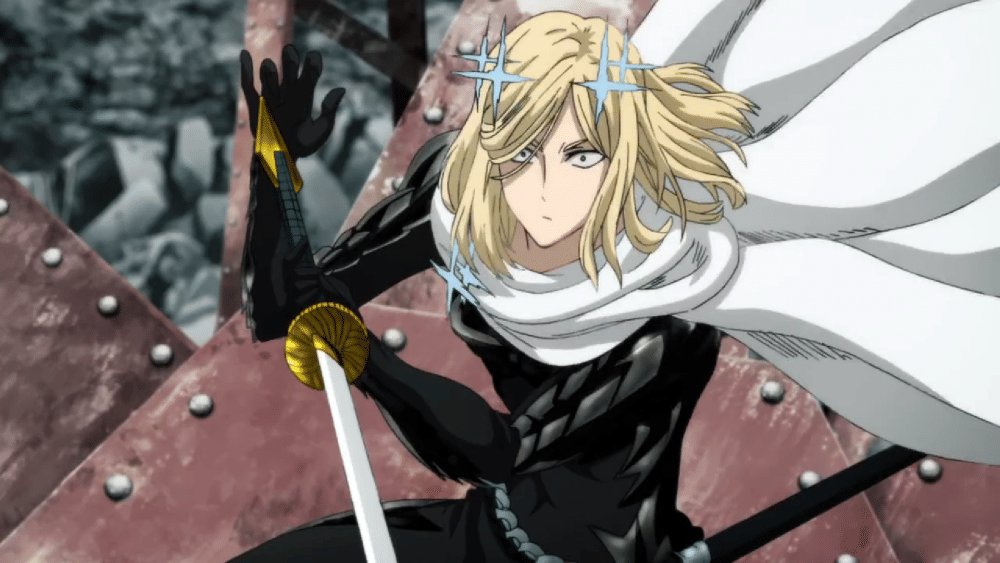
In One Punch Man, the Hero Association loves numbers. Every professional hero gets a class and a rank, and the public treats those rankings as a scoreboard of strength. Flashy Flash, the long-haired ninja with a katana and an ego to match, has spent most of the story sitting at Rank 13 in the S-Class, below names like Zombieman and the infamous King. Yet every time he actually draws his sword, he looks like one of the most dangerous heroes alive. So is Flash simply misplaced? Let’s look at what he has shown, why the ranking undersells him, and where his real limits lie.
Who Is Flashy Flash?
Flash debuts in Chapter 30 of the manga (Episode 10 of the anime) as one of the S-Class heroes summoned to the emergency meeting about a seer’s prophecy of global disaster. He barely speaks at first, which fits his personality: calm, blunt and convinced that he is the best fighter in the room. He brushes lower-ranked heroes aside, talks back to Tatsumaki without a hint of fear, and even accuses her of stealing his kill against the Hundred-Eyes Octopus.
His background explains a lot. Flash grew up in the Ninja Village, a hidden institution that took in young children and turned them into professional killers through years of brutal training. He was the top student of the 44th graduating class, the generation known as “The End”, alongside his old classmate Speed-o’-Sound Sonic. At sixteen, on graduation day, Flash wiped out the village almost single-handedly, sparing only Sonic. He later joined the Hero Association and registered his own hero name, which is simply the name he had carried since his village days.
The Feats That Don’t Match Rank 13
Two Dragon-Level Ninjas at Once
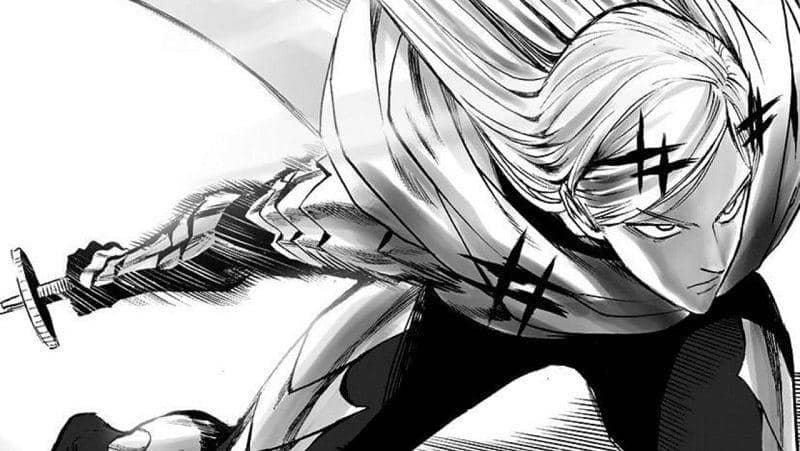
Flash’s signature moment comes during the raid on the Monster Association’s headquarters (Chapters 98 and 99). Two former Ninja Village graduates, Gale Wind and Hellfire Flame, ate monster cells and became Dragon-level threats, all to take revenge on the man who destroyed their home. Flash fought both at the same time, kept up with their speed, deliberately let them press the attack, stunned them with his Flash Kicks, retrieved his sword and cut both of them in half with Flash Slash before either could react. When they asked, while dying, what they had lacked, his answer was simply more training.
Context matters here. During the same raid, several S-Class heroes were pushed to their limits by individual Dragon-level monsters. Flash took down two together without serious injuries, and he became the first S-Class hero shown defeating a Dragon-level monster entirely on his own.
Praise From People Who Know Strength
- Superalloy Darkshine: After his own fight with Garou, Darkshine remarks that if the half-monster Garou he had just faced ran into Flash, the Hero Hunter would most likely die on the spot (Chapter 130).
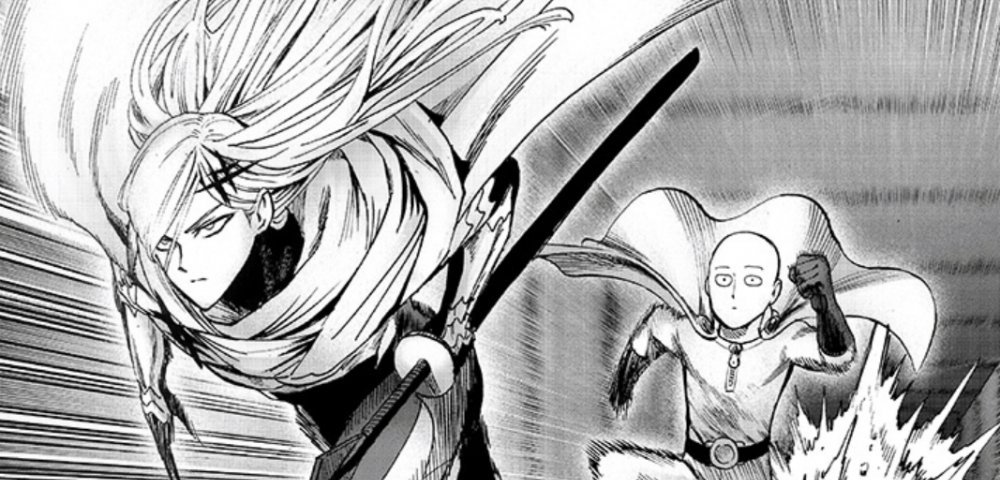
- Saitama: While traveling with Flash underground, Saitama calls him fairly fast, which from Saitama counts as high praise (Chapter 129).
- Sonic: In the recent Ninja Village arc, Sonic finally challenges Flash to settle who is stronger. Flash controls the duel from start to finish, and when the Heavenly Ninja Party ambushes them, he holds off a crowd of veteran ninjas without taking a clean hit until Blast steps in.
A Thinking Fighter
Flash is not just quick. He times his finishing moves so that neither enemy can escape, reads opponents’ patterns, and can estimate Saitama’s weight just from the sound of his footsteps (Chapter 119). His style is pure body and blade, with no flashy jutsu, yet his technique list is long: slashes, kicks, afterimage steps and a set of “forbidden” techniques he has never had time to use.
So Why Is He Only Rank 13?
The Ranking Is Not a Power Ladder
The Hero Association ranks heroes by a mix of results, contribution and reputation, not by who would win a duel. The clearest proof is King, who sat high in the S-Class purely on a reputation built from Saitama’s victories. If King can be ranked above Flash, the number next to Flash’s name says very little about his sword.
He Works Quietly
A popular explanation among fans is that Flash simply does not advertise his work. He is a ninja by training: fast, silent and uninterested in cameras. Many of his kills likely never reach the Association’s records, and he never seems to care about climbing the list. Since his rank is partly based on reported achievements and public image, a hero who never reports anything will drift down the table.
His Hero Profile Has a Weak Spot
The Association’s official profile of Flash rates him highly in combat categories, but gives him a Justice score of 5, the lowest known among all S-Class heroes. Whatever his private motives, the people grading him clearly do not see him as a model of heroic idealism.
Where His Limits Really Are
None of this makes Flash an untouchable top-tier hero. His record shows clear weaknesses:
- Pride under pressure: Flash loses his composure when someone is faster than him. Saitama dodged him effortlessly, Blast slipped behind him without effort, and Platinum Sperm noted that Flash fights to protect his pride rather than to win once he is outsped.
- Limited finishing power: Many fans point out that his speed is far ahead of his raw destructive force. Against extremely durable monsters, he can struggle to land a decisive blow.
- Bad matchups: Without his sword, he could not hold off an evolving Garou and Platinum Sperm at the same time (Chapters 160 and 161). He was outclassed, though he lasted longer than many would.
- Debated feats: Some readers argue that Gale Wind and Hellfire Flame were only borderline Dragon-level, and that his greatest win came against fighters trained in exactly the same style as him.
Where Does He Really Belong?
A common fan tier list puts Tatsumaki far ahead of everyone, followed by Bang, and then a tight group of Flash, Superalloy Darkshine and Atomic Samurai. Each member of that group dominates a different kind of opponent: Darkshine crushes slower brawlers, Atomic Samurai is the most complete swordsman, and Flash is near unbeatable against fast, humanoid enemies. On raw ability, that puts him comfortably in the S-Class top five, far above his official Rank 13.
Conclusion
Flashy Flash is almost certainly stronger than his S-Class rank suggests. His speed, technique and record against Dragon-level threats put him in the same conversation as the Association’s elite, and the ranking system, built on reputation and reported results, was never designed to measure a silent ninja who refuses to self-promote. His real limits are not his number but his pride and his lack of overwhelming destructive power.
With the Ninja Village saga now pulling Flash into the spotlight, one question remains: will the Hero Association ever rank him where his sword says he belongs, or will Flash keep being the strongest hero nobody ranks properly?