One Punch Man began as a one-joke comedy: a hero so strong that every fight ends with a single punch. The Monster Association arc is where that joke grew into an epic. It took Yusuke Murata’s remake of ONE’s story around five years of serialisation, it pits almost every S-Class hero against an army of monsters, and it turns Garou, the Hero Hunter, into one of the best antagonists in modern manga. With the anime’s third season now finally bringing the arc to the screen, it is the perfect time to ask: why is the Monster Association arc One Punch Man‘s greatest story?
The Setup – Heroes Against an Organised Army
For most of the series, monsters attack alone. The Monster Association changes the rules. Led by the Monster King Orochi and the psychic strategist Gyoro Gyoro, hundreds of monsters gather in a fortress beneath an abandoned part of Z-City, turn humans into monsters with “monster cells”, and openly declare war on the Hero Association. They kidnap the son of a powerful association executive, along with Tareo, a young boy who idolises heroes.
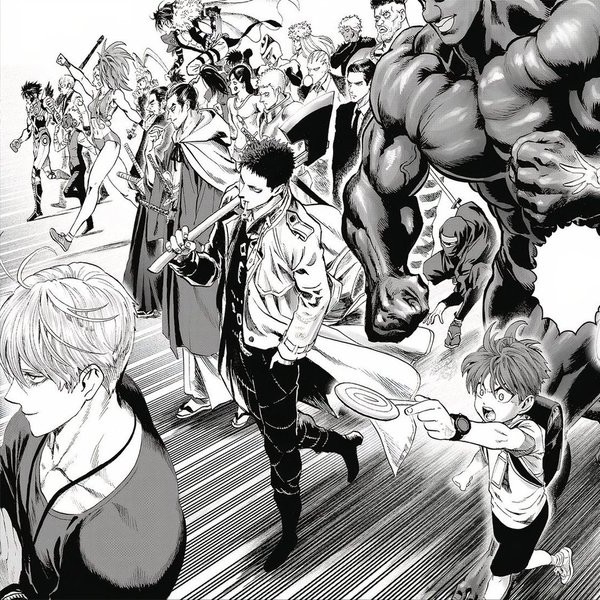
The Hero Association responds with something it has never tried: a full raid with nearly every S-Class hero at once. At the same time, Garou, hunted by heroes and monsters alike, is fighting his way through the same base on his own terms. Three stories run side by side, and they all collide at the end.
Reason 1: Garou’s Journey
The heart of the arc is Garou. He claims to want to become an absolute evil, a monster so terrifying that it unites humanity against it. Yet his actions keep contradicting his words:
- He protects Tareo: He storms the base and saves the boy from a monster, insisting the whole time that he is not there to rescue anyone.
- He refuses to be a bully: When Superalloy Darkshine, terrified for the first time in years, cries out in fear, Garou pulls back. Beating someone who has already given up feels to him like the petty cruelty he has always hated.
- He keeps his own code: He hunts heroes and beats them half to death, yet he never actually kills one, and he despises anyone who preys on the weak.
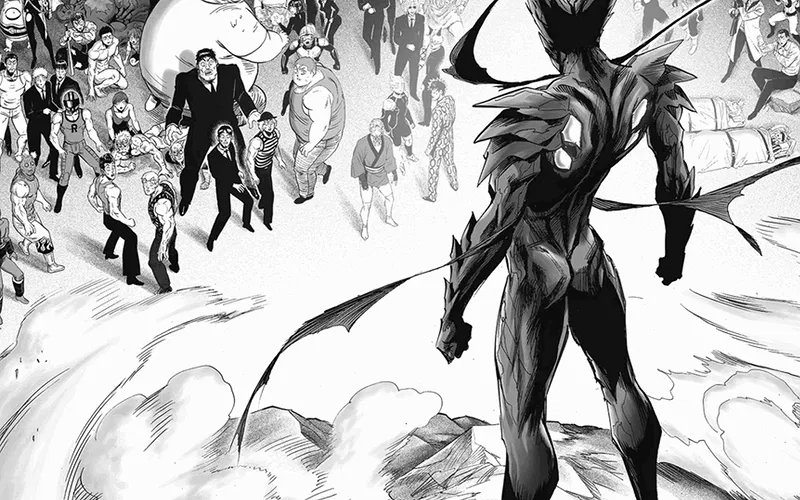
As the fights pile up, his body changes into something inhuman, until he finally emerges as a full monster before the assembled heroes. The tragedy is that his transformation is driven by a twisted love of justice. Many fans read Garou as the hero the story never let him become: a boy who, as a child, found himself sympathising with the monsters who always lost in hero shows.
Reason 2: Every Hero Gets a Moment
Earlier arcs often reduced S-Class heroes to bystanders who got beaten before Saitama arrived. The raid finally gives them space:
- Flashy Flash: Shows his blinding speed against two ninja monsters from his own village.
- Child Emperor: Survives a string of cadre-level monsters with nothing but gadgets and intelligence.
- Zombieman: His clash with the Homeless Emperor, a monster empowered by “God”, is one of the darkest fights in the series.
- Atomic Samurai: Faces Black Sperm, a monster that can split into countless copies of itself.
- Puri-Puri Prisoner, Pig God and Metal Bat: Each gets a scene that shows why they belong in S-Class, even when they lose.
- Tatsumaki: Rips the entire underground base out of the earth, the moment many readers remember first.
The result feels like a real war rather than a string of punchlines, and it makes the world of One Punch Man feel much bigger.
Reason 3: Orochi, Psykos and the Duel of Espers
Orochi is one of the remake’s biggest additions; the original webcomic had no Monster King. Under Gyoro Gyoro’s guidance, a human with an endless hunger for destruction was pushed through brutal “monsterization” until he became a towering beast able to copy his enemies’ techniques. Gyoro Gyoro turns out to be a puppet controlled by Psykos, a former classmate of Fubuki who saw something terrible when she opened her psychic third eye.
The fusion of Psykos and Orochi produces the arc’s most spectacular battle. Psykos gains enough power to tear up the earth’s crust and raise mountain-high waves, and she explains that during the fusion she met an entity she can only describe as something like God. Tatsumaki, pushed harder than ever before, holds the line until she and the other heroes finally bring the fused monster down.
Reason 4: Saitama Is Still Saitama
The arc never forgets its comedy. Saitama spends much of the raid lost in the base. He stumbles into Orochi’s lair and relaxes in a pool of lava while the Monster King lectures him about destiny, then finishes him without ever taking him seriously. He clears entire areas with one punch, flips the headquarters with a single motion, and treats an apocalyptic battle like a nuisance in his neighbourhood.
That contrast is what makes the final showdown with Garou work. Saitama crushes every monstrous evolution, then gives Garou a simple, devastating answer: deep down, Garou always had an ideal image of a hero, and he wanted to be one. When the heroes try to finish Garou off, it is Tareo who steps in, and Garou walks away with a new desire to live.
Reason 5: It Opens a Much Bigger World
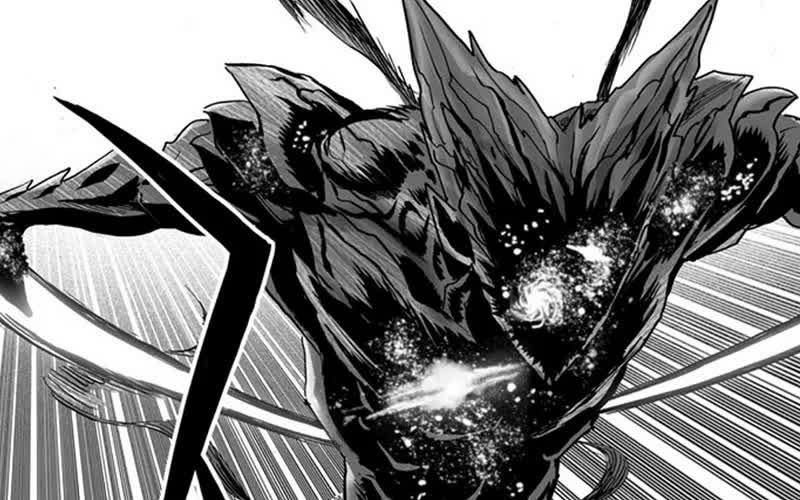
The Monster Association arc does not just end a story; it reveals the stakes of the next ones. Blast, the mysterious S-Class Rank 1, appears at last and is revealed to be fighting “God” alongside his own comrades. Garou is offered power by that same entity and becomes Cosmic Fear Garou, a form with a body full of galaxies, capable of copying Saitama’s own moves. Their final clash reaches a scale the series had never shown, with destroyed planets and a punch that travels back through time.
The Webcomic Versus Manga Debate
Fans still argue over which version tells the arc better. Some prefer the tighter, more personal ending of ONE’s webcomic, while others love Murata’s expanded fights, the God foreshadowing and the sheer artistry of the remake. Most agree that both versions show the series at its most ambitious.
Conclusion
The Monster Association arc is One Punch Man‘s greatest story because it uses everything the series has: an army of colourful heroes, villains with real ideas, spectacular art, and a comedic hero who still ends everything with one punch. Above all, it gives Garou a complete, painful arc about what it really means to be a hero.
Which moment from the Monster Association arc stays with you the most – Tatsumaki tearing the base out of the earth, Garou sparing Darkshine, or Saitama’s final words to the Hero Hunter?